
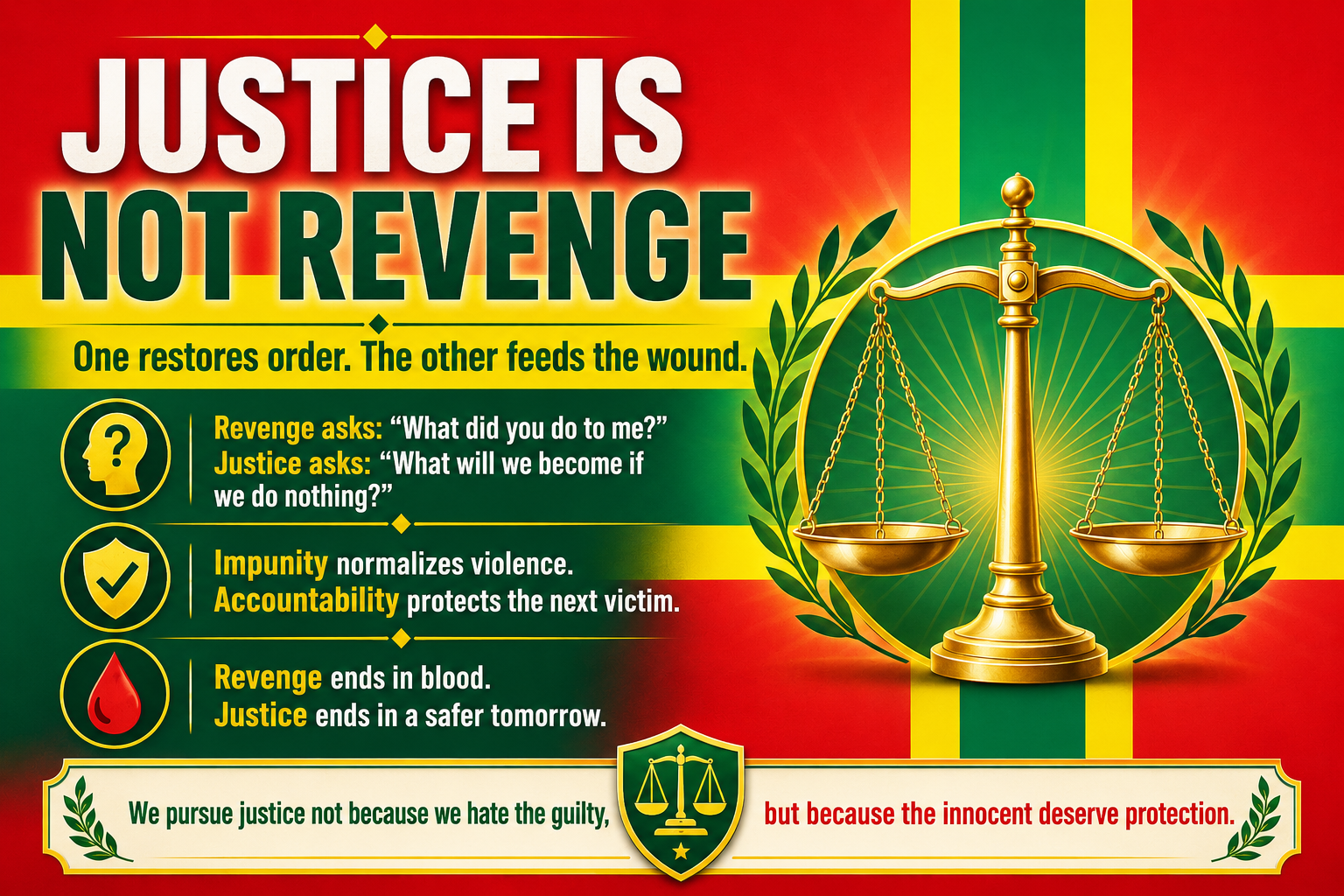
Justice Is Not Revenge: One Restores Order. The Other Feeds the Wound.
When violence strikes a community — a child harmed, a family terrorized, a killer who seems to walk free — the cry for blood is loud. It is also human.
But human instinct is not the same as sound policy. If we are not careful, we will tear down the very institutions meant to protect us, all in the name of satisfying our wounds.
Let us be absolutely clear: justice is not revenge.
The Core Difference
Justice preserves peace, security, and public confidence. Revenge merely feeds the wound.
Revenge asks: “What did you do to me?” It is backward-looking, emotional, and blind. It seeks a moment of satisfaction — often cruel, often excessive, always personal.
Justice asks: “What will we become if we do nothing?” It is forward-looking, measured, and evidence-based. It seeks a future without another victim.
A society that allows murder, torture, and intimidation to go unanswered does not become compassionate. It becomes lawless.
The Danger of Impunity
When serious crimes go without accountability, something deeper than the original injury is lost.
Fear becomes habit. The vulnerable learn silence. Law-abiding citizens lose confidence in the very institutions sworn to protect them. They buy guns. They form neighborhood militias. They take the law into their own hands.
That is not liberation. That is the collapse of trust.
Impunity normalizes violence. What goes unpunished becomes, in the public mind, acceptable. When violence becomes normal, no one is safe — especially the innocent, the weak, and the already unheard.
The False Argument
Some will argue that punishment is vengeance dressed in robes. They will say that prisons are cruelty, that prosecution is retaliation, that to hold someone accountable is to sink to the criminal’s level.
This is a seductive but dangerous lie.
Accountability is not revenge because revenge ends a story in blood — while justice ensures the next chapter is not written in fear. One destroys. The other protects.
We do not pursue justice because we hate the guilty. We pursue it because the innocent deserve to sleep without the weight of unanswered violence pressing on their chests.
What Justice Actually Looks Like
Justice is not soft. It is not weak. It is not a plea for forgiveness in the face of atrocity.
Justice is:
- A fair trial based on evidence, not emotion.
- A sentence proportionate to the harm caused.
- Protection for future victims before they exist.
- Public confidence that the system works for everyone — not just the powerful or the loud.
Revenge gives you one night of satisfaction. Justice gives you decades of safety.
“Revenge asks, ‘What did you do to me?’
Justice asks, ‘What will we become if we do nothing?'”
A Call to Community Leaders
To elected officials, law enforcement, religious leaders, educators, and every person who holds influence in this community:
Do not confuse toughness with wisdom. Do not mistake cruelty for consequence. Do not let outrage write your laws.
Demand accountability — but accountability that is fair, transparent, and forward-looking. Reject policies born of revenge disguised as justice. Protect the innocent not with anger, but with systems that work.
“Revenge looks backward at a wound. Justice looks forward at a society that must not bleed again.”
We pursue justice not because we hate the guilty, but because the innocent deserve protection.
Revenge ends in blood.
Justice ends in a safer tomorrow.
Choose which society you want to live in.
“Impunity normalizes violence. Accountability protects the next victim.”
“Justice restores order. Revenge just feeds the wound.”
About This Article
This piece is an op-ed contribution to ZPCC.Net. The views expressed are those of the ZPCC Editorial Board and are intended to foster community dialogue on justice, accountability, and public safety.