In an era of historical distortion, assimilation pressures, and fragmented diaspora communities, the institutional reaffirmation of Zomi identity, Zomi National Day (February 20), and the collective Zomi political future is not merely symbolic—it is an essential act of survival to preserve indigenous heritage, correct historical narratives, unite a global community under a shared destiny, and assert the fundamental right of ‘ကိုယ့်ကြမ္မာ ကိုယ်ဖန်တီးခွင့်’ (the right to shape one’s own destiny) for generations yet unborn. Therefore, the concept of “institutional reaffirmation” is a common thread in how groups and governments maintain stability and identity. This is even more so important for the Zomi people in the era of historical distortion, assimilation pressures of a fragmented diaspora.
Component: “Era of historical distortion, assimilation pressures, fragmented diaspora”
Purpose: Identifies the urgent threats facing the Zomi community today.
Component: “Not merely symbolic—essential act of survival”
Purpose: Elevates reaffirmation from ceremony to necessity.
Component: “Preserve indigenous heritage”
Purpose: Addresses cultural continuity.
Component: “Correct historical narratives”
Purpose: Directly supports the rebuttal against the 2019 “creation” myth.
Component: “Unite a global community”
Purpose: Recognizes the worldwide Zomi diaspora.
Component: “ကိုယ့်ကြမ္မာ ကိုယ်ဖန်တီးခွင့်”
Purpose: Incorporates the Burmese phrase from your earlier document, connecting language to rights.
Component: “Generations yet unborn”
Purpose: Emphasizes intergenerational responsibility.
Fact Sheet: Zomi Nam Ni (ဇိုမီးအမျိုးသားနေ့)
| Attribute | Details |
| Name | Zomi Nam Ni / ဇိုမီးအမျိုးသားနေ့ (Zomi National Day) |
| Date | February 20 (annually) |
| Historical Origin | 1948 – Falam Conference, Chin Special Division, Myanmar. |
| Foundational Event | A historic Zomi convention at Falam decided to reject autocratic rule and embrace democracy on February 20, 1948. It is commemorated as a “day of deliverance” from colonialism. |
| Year First Observed | Observed continuously since 1948 in Zogam and by the global Zomi diaspora. |
| 2019 Event Status | Institutional Reaffirmation – The 2019 Kuala Lumpur Conference reaffirmed the day, it did not create it. |
📌 Comprehensive Explanation
To understand Zomi Nam Ni, one must distinguish between its historical origin and its modern institutional reaffirmation.
1. The Historical Origin (1948)
Zomi Nam Ni traces its foundation to the Falam Conference, held from February 18–20, 1948, within the Chin Special Division (Myanmar).
- The Event: Thousands of Zomi leaders gathered for a historic convention at Falam.
- The Decision: On February 20, 1948, they unanimously decided to reject autocratic rule and embrace democratic governance. This marked a transition away from traditional chieftainships toward a modern administrative system.
- The Meaning: It is a day commemorating “deliverance” from colonialism and autocracy, celebrating indigenous identity and the right to political self-determination.
- Continuous Observance: Since 1948, this day has been observed continuously by Zomi communities across Zogam (in Myanmar and India) and the diaspora. A 2012 report from the Times of India confirms that celebrations were already being held simultaneously in cities like Imphal, Singapore, Tokyo, Washington, London, and Rangoon.
2. The 2019 Institutional Reaffirmation (Kuala Lumpur)
The Zomi International Conference 2019 (ZIC2019KL), held in Kuala Lumpur, Malaysia from February 17-19, 2019, was a milestone event. However, its role was specific.
- What it Did: The conference brought together over 70 representatives from Myanmar, India, the US, Canada, and Japan to build consensus and lay out a strategic roadmap for the future.
- The Key Action: Reaffirmation. The primary political act of the conference was to issue the Kuala Lumpur Declaration. The very first line of this declaration states: “We reaffirm our Zomi identity as an indigenous people; and resolve to continue working towards achieving our political goal of establishing a self-administered Zogam…” . This declaration also initiated the drafting of the Zogam Charter and articulated Zogam Mabante (Zogam’s political objectives).
- Official Clarification: The Zomi Political Coordination Council (ZPCC) has explicitly clarified that the 2019 conference did not create Zomi Nam Ni. It formally stated:
- 1948 = Historical Origin
- 2019 = Institutional Reaffirmation
Addressing the Misinterpretation
A Burmese-language claim, which translates to:
“In accordance with the resolution of the International Zomi National Conference held in Kuala Lumpur, Malaysia, in February 2019, the Zomi Political Coordination Council (ZPCC) designated it as Zomi National Day.”
ကိုယ့်ကြမ္မာ ကိုယ်ဖန်တီးခွင့်နှင့် ကိုယ်ပိုင်ဆုံးဖြတ်ပိုင်ခွင့် ရရှိရေးအတွက် လမ်းခင်းပေးခဲ့သော အဆိုပါ နေ့ထူးနေ့မြတ်အား ဇိုမီး နိုင်ငံရေးဆိုင်ရာ ပူးပေါင်းဆောင်ရွက်ရေး ကောင်စီ (Zomi Political Coordination Council) မှ ၂၀၁၉ ခုနှစ် ဖေဖော်ဝါရီလ တွင် မလေးရှားနိုင်ငံ ကွာလာလမ်ပူ မြို့၌ ကျင်းပသော နိုင်ငံတကာ ဇိုမီးအမျိုးသား ညီလာခံ၏ ဆုံးဖြတ်ချက်နှင့်အညီ ဇိုမီး အမျိုးသားနေ့ အဖြစ်သတ်မှတ်ခဲ့ခြင်း ဖြစ်သည်။
This statement is factually incorrect and conflates “designation” with “reaffirmation.”
- The Error: The claim suggests the day was established or designated in 2019.
- The Truth: The day was established in 1948 through the will of Zomi leaders at Falam. It has been observed for over 70 years.
- Why the Confusion Occurs: Large, historic conferences like the one in 2019 often issue formal declarations that restate and recommit to foundational principles. The 2019 Kuala Lumpur Declaration is a powerful document of reaffirmation, not a certificate of creation. The ZPCC’s role was to consolidate the political objectives (Zogam Mabante) and initiate the Zogam Charter, building upon the legacy of 1948, not to replace it.
Examples of Institutional Reaffirmation Worldwide
The following examples illustrate how different types of organizations and governments actively recommit to their foundational principles.
| Event/Institution | Context of Reaffirmation | Date | Key Principle Reaffirmed |
| José Martí Cultural Association | Annual meeting commemorating Fidel Castro’s centenary and the 67th Anniversary of the Cuban Revolution. | February 2026 | Solidarity with Cuba and opposition to the U.S. embargo. |
| Simón Bolívar’s Ideals | 207th anniversary of Simón Bolívar’s “memorable speech” at the Congress of Angostura. | February 2026 | Ideals of freedom, social equality, and political stability. |
| Liberia National Elections Commission | Formal signing of a communiqué after a five-day strategic retreat. | February 2026 | Commitment to credible elections for Liberia’s democratic stability. |
| Oklahoma State Senate | Introduction of Senate Resolution 24 for America’s 250th anniversary. | February 2026 | Foundational principles of the Declaration of Independence (e.g., unalienable rights). |
| Kaduna State House of Assembly | Public address to protesters demanding updates on a legislative probe. | February 2026 | Commitment to transparency and constitutional responsibilities. |
Analyzing These Events
To understand how these events function similarly to the Zomi National Day reaffirmation, consider them through these three lenses:
- Ceremonial or Commemorative Context:
Like the Zomi National Day, most reaffirmations are tied to a significant anniversary. This provides a natural moment for reflection and recommitment. For instance, the reaffirmation of Simón Bolívar’s ideals was anchored to the 207th anniversary of the Angostura speech, while the Oklahoma resolution was part of the lead-up to America’s 250th birthday. - Formal and Public Declaration:
Reaffirmation requires a public, often official, act. This can take the form of a signed communiqué by all seven commissioners of Liberia’s election board, a legislative resolution introduced in the Oklahoma Senate, or a public address by a government official, as seen in Kaduna and Venezuela. This public nature signals seriousness and collective buy-in. - Confronting Current Challenges:
The reaffirmation is rarely abstract; it directly addresses contemporary pressures. For the José Martí Association, reaffirming solidarity with Cuba was a direct response to the “intensifying brutal aggression of U.S. imperialism”. Similarly, the Kaduna Assembly’s reaffirmation of its probe was a response to public protests demanding accountability. The reaffirmation becomes a tool to bolster the institution against current threats.
These examples provide a useful framework for understanding how groups around the world actively work to sustain their core institutions. Would you be interested in exploring the specific outcomes or impacts of any of these reaffirmation events.
In essence, saying 2019 created Zomi Nam Ni is like saying the U.S. Congress “created” Independence Day every time it passes a resolution reaffirming the importance of July 4, 1776. The 2019 conference honored the 1948 origin and gave it renewed political force for the modern era.
Below are some examples of institutional reaffirmation, the way the ZICKL rectified the Zomi identity, Zomi political aspiration, Zogam future, and the Zomi National Day, respectively.
🏛️ 1. European Parliament
Type: Supranational Government
When: November 2020
What they did: Adopted the EU Action Plan on Human Rights and Democracy (2020–2024) .
Principle reaffirmed: Promoting and protecting human rights and democracy globally.
📋 2. Human Resources Professionals Association (HRPA)
Type: Professional Regulatory Body
When: 2019
What they did:
Approved a new Strategic Plan (2019–2021) titled “Inspiring
Professionalism.”
Principle reaffirmed:
The vision, mission, and values of the HR profession in Ontario.
🇬🇭 3. Government of Ghana
Type: National Government
When: December 2021
What they did: Appointed four national focal points to promote the ILO’s MNE
Declaration.
Principle reaffirmed:
Principles of decent work, social policy, and responsible business conduct.
💼 4. Business Roundtable
Type: Corporate Association (CEOs)
When: 2019
What they did: Released a revised “Statement on the Purpose of a Corporation.”
Principle reaffirmed:
Commitment to serve all stakeholders (customers, employees, suppliers,
communities, and shareholders), not just shareholders.
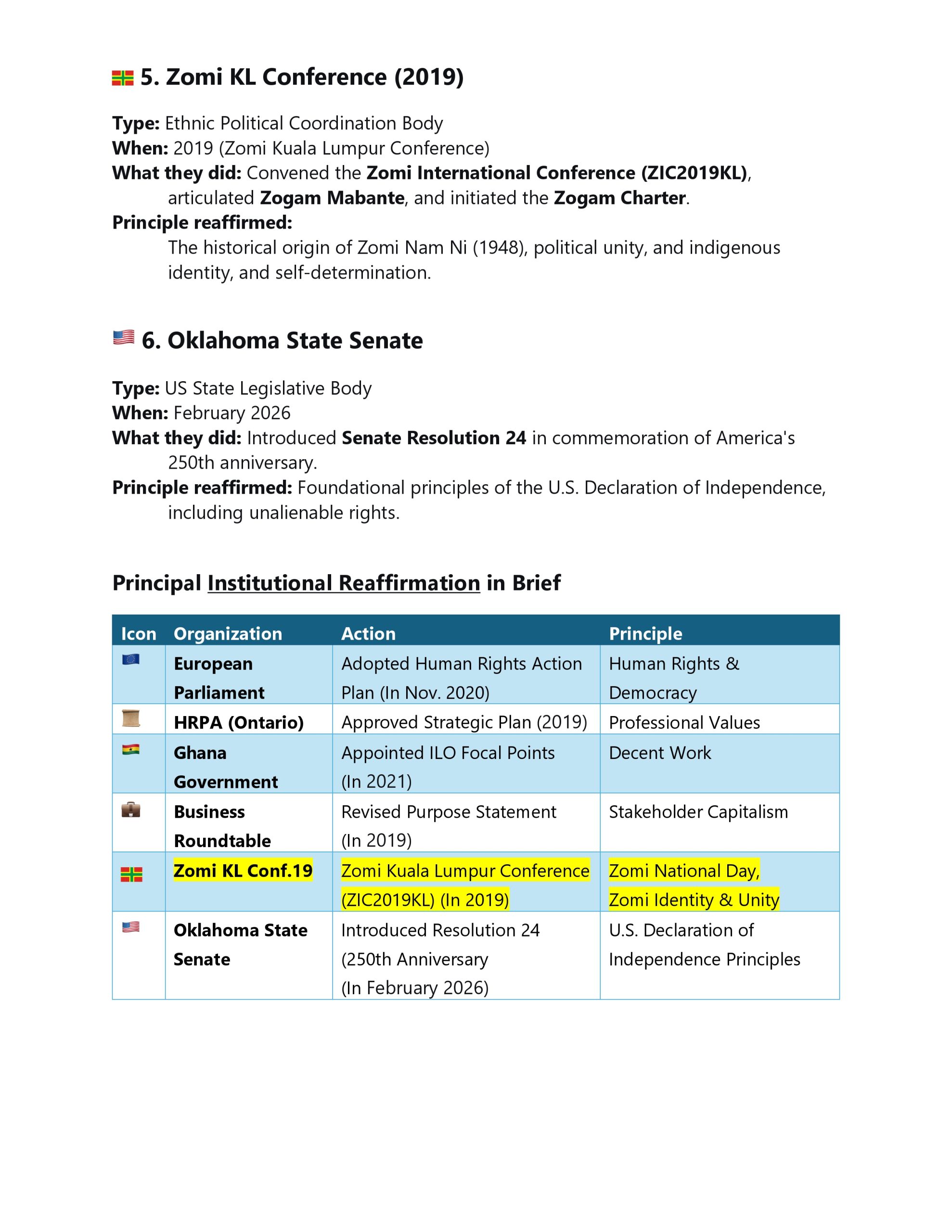
5. Zomi KL Conference (2019)
Type: Ethnic Political Coordination Body
When: 2019 (Zomi Kuala Lumpur Conference)
What they did: Convened the Zomi International Conference (ZIC2019KL),
articulated Zogam Mabante, and initiated the Zogam Charter.
Principle reaffirmed:
The historical origin of Zomi Nam Ni (1948), political unity, and indigenous
identity, and self-determination.
🇺🇸 6. Oklahoma State Senate
Type: US State Legislative Body
When: February 2026
What they did: Introduced Senate Resolution 24 in commemoration of America’s
250th anniversary.
Principle reaffirmed: Foundational principles of the U.S. Declaration of Independence,
including unalienable rights.
Principal Institutional Reaffirmation in Brief:
| Representations Symbols | Organization | Action | Principle |
| 🇪🇺 | European Parliament | Adopted Human Rights Action Plan (In Nov. 2020) | Human Rights & Democracy |
| 📜 | HRPA (Ontario) | Approved Strategic Plan (2019) | Professional Values |
| 🇬🇭 | Ghana Government | Appointed ILO Focal Points (In 2021) | Decent Work |
| 💼 | Business Roundtable | Revised Purpose Statement (In 2019) | Stakeholder Capitalism |
| Zomi KL Conf.19 | Zomi Kuala Lumpur Conference (ZIC2019KL) (In 2019) | Zomi National Day, Zomi Identity & Unity | |
| 🇺🇸 | Oklahoma State Senate | Introduced Resolution 24 (250th Anniversary (In February 2026) | U.S. Declaration of Independence Principles |